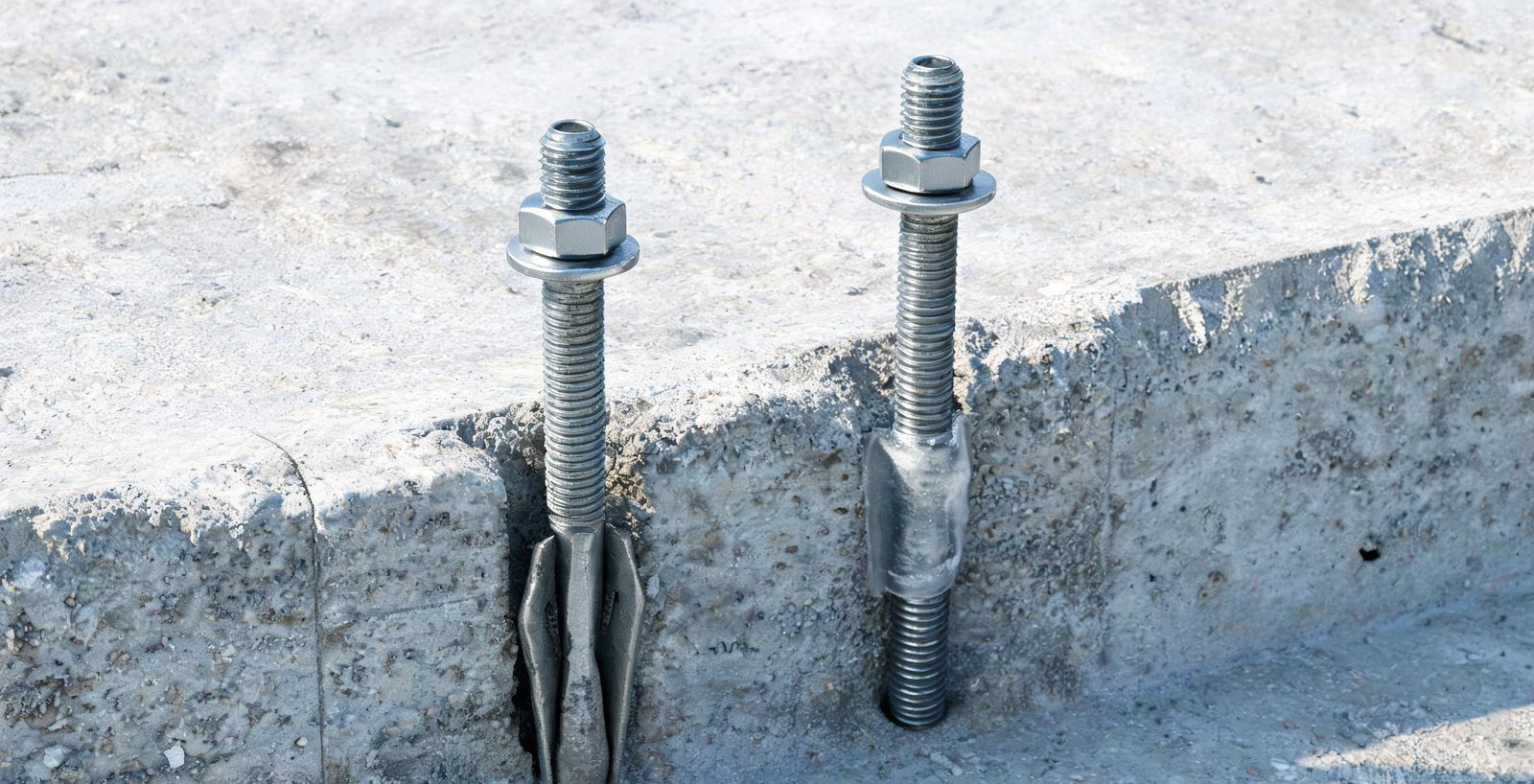
Almost every concrete fixing decision comes down to one question: do you want the anchor to grip by mechanical interference, or by bonding? Both work, both fail in different ways, and the right answer depends on the base material, the load type, and how much room you have around the fixing.
Mechanical anchors generate capacity through direct contact. A wedge anchor expands a collar against the bore as the nut is tightened, producing friction and bearing against the concrete. A sleeve anchor expands a sleeve along a longer length, which suits softer masonry and hollow block. A drop-in anchor is set with a setting tool and then accepts a separate screw or rod, which is convenient when the fixture must be removable. Mechanical anchors are fast, immediately loadable, and work in a wide temperature range. Their weakness is sensitivity to hole quality: an oversized or poorly cleaned hole, or a hole drilled too close to an edge, cuts capacity sharply.
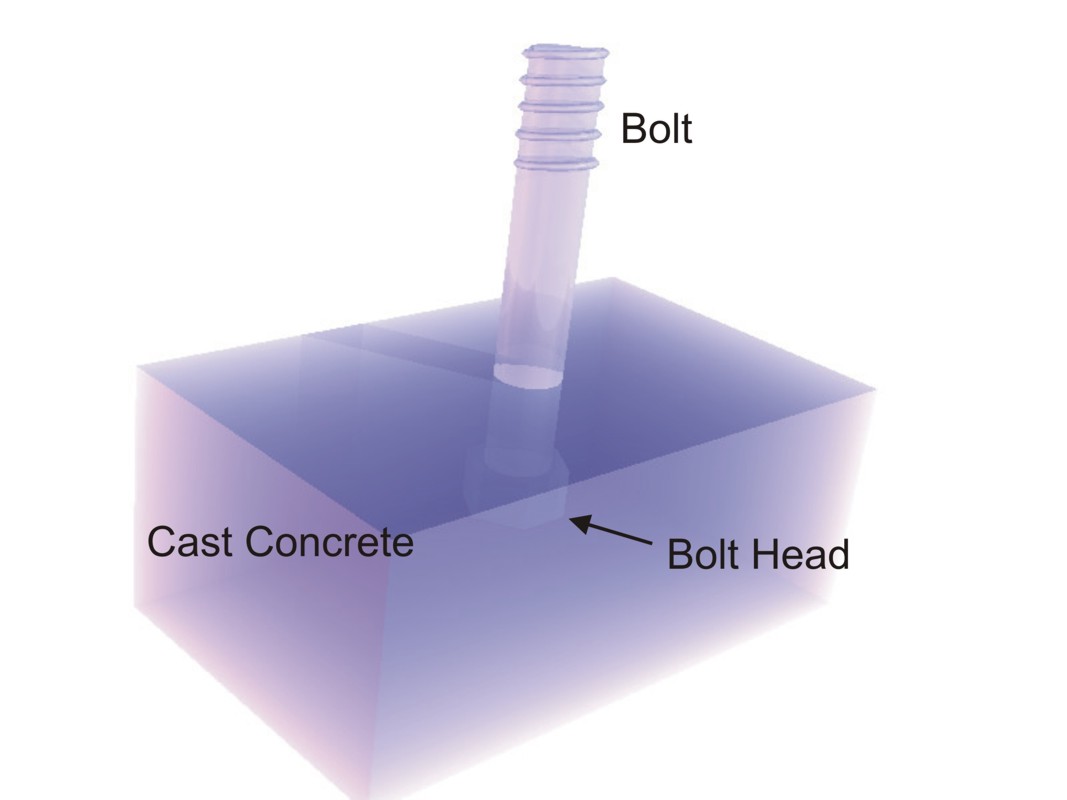
Chemical anchors bond a threaded rod into the concrete with a two-part resin. The resin fills the bore, cures, and transfers load along the embedment length. They suit heavy loads, close edge distances, small base thicknesses, and applications where vibration would loosen a mechanical wedge. They also allow rebar to be avoided by design rather than discovered by accident. The trade-off is cure time, temperature sensitivity, and cleanliness - a dusty hole can reduce bond strength dramatically.
Cracked concrete is the dividing line most specifications care about. Structural connections in tension zones, seismic regions, and slab edges must assume cracks may open through the anchor location. Only anchors tested and qualified for cracked concrete should be used there, and both mechanical and chemical products exist that meet that requirement. If your project drawings call for cracked-concrete approval, check the test report rather than the catalogue photo.
Edge distance and spacing follow the same logic for both families. A wedge anchor at two diameters from an edge behaves very differently from one at five diameters. Chemical anchors often permit tighter spacing because load spreads along the bonded length, but only within the limits stated in the approval document. Where several anchors work as a group, the group capacity is rarely the sum of individual capacities - pull-out cones overlap and the concrete controls the failure.
Practical selection rules that hold up on most projects: use mechanical anchors for repetitive, light-to-medium static loads in sound concrete with generous edge distance; use chemical anchors for heavy loads, close edges, thin slabs, dynamic or vibrating equipment, and where the fixing may need to be re-drilled later. In wet or chemically aggressive environments, choose stainless steel components and confirm the resin is rated for the service temperature.
Whichever family you choose, the installation method is half the product. Hole diameter, drilling method, blow-out cleaning, embedment depth, and curing time before loading all appear in the approval document for a reason. A crew that ignores them can turn a certified anchor into an unrated one.
Matrix Fasteners supplies wedge anchors, sleeve anchors, drop-in anchors and threaded rods for chemical anchoring, in zinc-plated, hot-dip galvanized and stainless steel A2 and A4 versions, with test reports on request. Send your base material, load and edge distance and we will recommend a suitable anchor family and size.