A bolted joint that self-loosens rarely produces a small failure - covers detach, wheels shift, flanges leak, and machinery develops secondary damage. Most loosening begins the same way: side-to-side movement or vibration causes repeated microscopic slip between the contact surfaces, and the nut rotates off in tiny increments. Prevention starts with understanding why it happens.
First, a design note: a properly preloaded bolt should not loosen in the first place. If clamping force exceeds the external separating and sliding loads, the joint stays locked because friction at the threads and under the nut does the work. Step one on any reliability problem is therefore to verify preload - correct grade, correct torque, surfaces cleaned or lubricated per specification, and a properly tightened rather than bottomed-out joint.
When the joint itself cannot provide enough preload or it sees heavy vibration, engineers add a locking method. The established choices are not interchangeable, and matching the device to the duty matters.
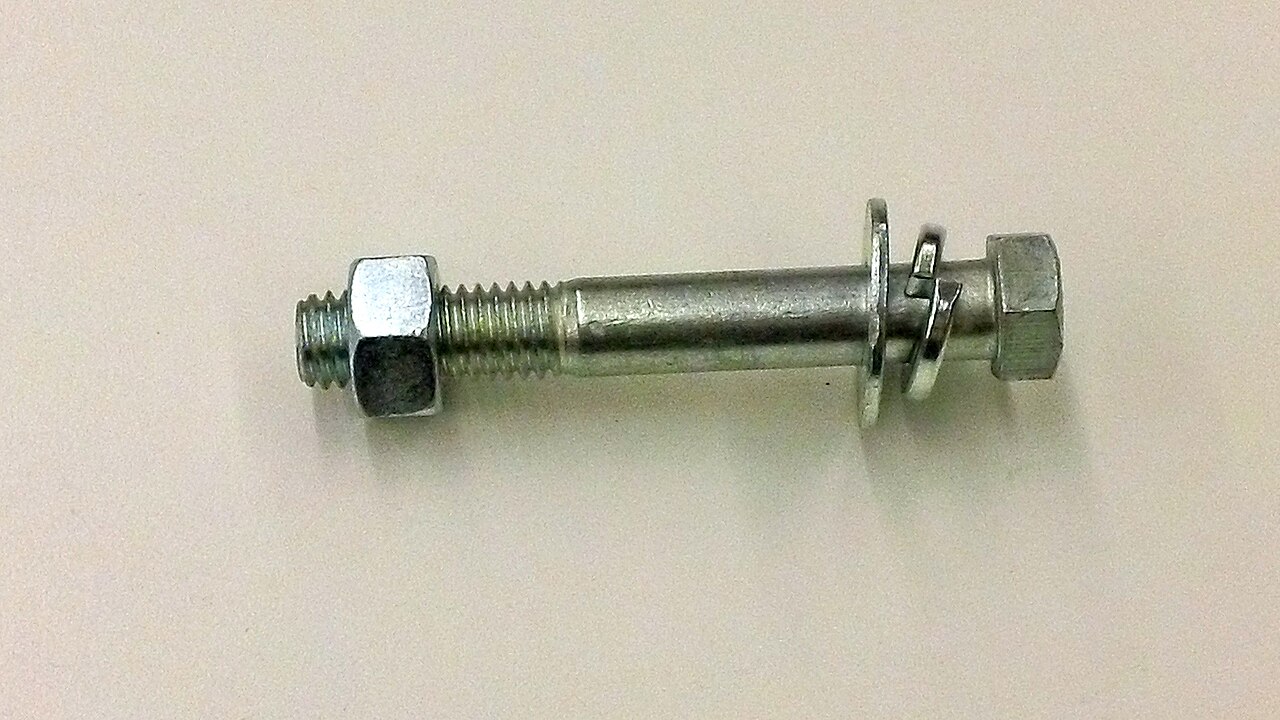
Spring lock washers - the split, twisted washers seen everywhere - are the cheapest and most familiar addition. They increase bearing tension while tightening and score the contact surface. They work adequately against mild back-off in low-demand assemblies, but independent transverse-vibration testing shows they do not reliably stop loosening under sustained vibration; choose them with realistic expectations.
Serrated and wedge-locking washers are a different class. Wedge-locking washer pairs present cam ramps against each other: any attempt to rotate the nut backward lifts it over the ramps and is blocked by increased bolt tension. They excel under dynamic vibration on heavy equipment, truck components, and mining machinery - provided the contact surfaces are hard enough and the joint reaches the required preload.
Nylon insert lock nuts (Nyloc, DIN 985) add a prevailing torque: the nut spins freely until the threads enter a nylon collar, which grips the bolt. They are reusable a limited number of times and suit vehicles, bicycles, furniture, and equipment that is serviced occasionally. All-metal prevailing-torque lock nuts (DIN 980) use deformed threads instead of nylon, handling heat, UV, and chemicals in engine, exhaust, and industrial service.
Chemical threadlocking fills the thread gap with anaerobic adhesive. Low-strength (purple) products suit small screws and adjustment fasteners; medium-strength (blue) is the general automotive and machinery standard, removable with hand tools; high-strength (red) is for permanent joints and requires heat to dismantle. Threadlocker is inexpensive, seals against corrosion, and performs extremely well in vibration testing - its main limitation is poorly prepared, contaminated threads.
For joints that absolutely must never separate - steering, suspension, aircraft, lifting equipment - mechanical positive locking is the gold standard: castle nuts with cotter pins, tab washers bent onto flats, lock wire tying bolt heads together, or deformed lock plates. These do not depend on friction or chemistry at all.
Practical matching advice: use Nyloc or medium threadlocker for most general machinery; wedge-locking washers where service temperatures and heavy vibration rule out polymer; prevailing-torque all-metal nuts for hot and dirty industrial joints; and positive locking for safety-critical connections. Never stack multiple devices hoping for extra security - incorrect combinations often reduce the achievable preload instead.
Matrix Fasten supplies DIN 985 nylon insert nuts, DIN 980 all-metal lock nuts, spring and flat washers, wedge-locking washer sets, and matching grade 8.8 and 10.9 bolts as complete assemblies. Tell us the application and vibration conditions, and we will help you pair the locking method with the bolt grade.