Stainless steel fasteners prevent rust, look clean, and last for decades - but "stainless" is a family, not a single material. The two grades buyers meet most often are 304 and 316. Choosing between them correctly can prevent either a corrosion failure or a significant waste of money.
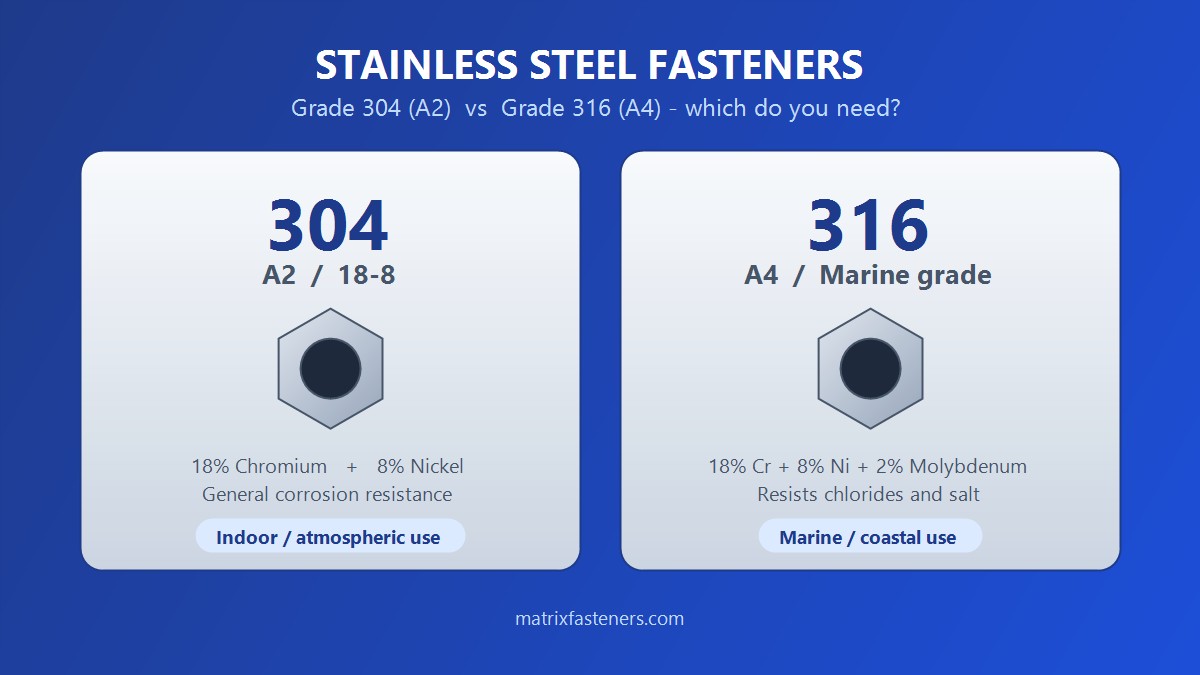
Grade 304 is the classic austenitic stainless steel, also called 18-8 because it contains roughly 18% chromium and 8% nickel. In fastener standards it corresponds to ISO 3506 group A2, and most 304 bolts and screws are delivered in property class A2-70 (700 MPa tensile). 304 machines and forms well, takes a bright finish, and is the volume leader for screws, hex bolts, washers, and threaded rod.
Grade 316 adds roughly 2 to 2.5% molybdenum to the chromium-nickel base. That single addition sharply improves resistance to chlorides, salts, and reducing acids. In ISO 3506 terms, 316 belongs to group A4, commonly supplied as A4-80 fasteners (800 MPa) or the softer A4-70. 316 is often called marine grade, although full seawater immersion still requires caution.
Where does 304 do the job? Indoor and atmospheric environments: kitchens and food processing equipment, furniture and railings, electrical enclosures, HVAC, interior architecture, freshwater plumbing, fencing, and general outdoor use away from the coast. In these conditions, a passive chromium oxide film self-repairs after scratches and visible rust rarely appears.
Where is 316 worth the premium? Coastal buildings exposed to salt spray, boats and deck hardware, swimming pool environments, chemical and pharmaceutical plants, wastewater treatment, roads treated with de-icing salts, and food lines exposed to brines or aggressive cleaning chemicals. The molybdenum specifically resists pitting corrosion - the localized attack that begins invisibly under salt deposits.
A practical comparison uses the pitting resistance equivalent number, or PREN: roughly 19-20 for 304 versus 25-26 for 316, calculated mainly from chromium, molybdenum, and nitrogen content. Chloride-rich service environments are specified using measures like this rather than appearance - a 304 bolt and a 316 bolt look identical on the bench.
How can you tell them apart on site? You reliably cannot by eye. Options include material test certificates, positive material identification with a handheld XRF gun (common on larger projects), and keeping color-coded packaging separated in the warehouse. Electrolytic spot-testing kits exist for smaller workshops.
Two buying notes. First, both grades are non-magnetic in the annealed condition, but cold-worked A2-70 fasteners can become slightly magnetic - magnetism is therefore not a reliable grade test. Second, galling is the main installation enemy of stainless nuts and bolts: use anti-seize lubricant where allowed, tighten slowly, and specify a work-hardened nut to reduce thread seizing.
For most general distributors, A2-70 covers about 80% of demand; stocking A4-80 hex bolts, coach screws, and threaded rod in the top-selling sizes captures coastal and marine customers without duplicating the whole range.
As a stainless steel fasteners supplier and exporter, Matrix Fasten carries 304/A2 and 316/A4 hex bolts, socket cap screws, machine screws, coach screws, washers, and threaded rod, with mill certificates and, on request, independent PMI verification. Tell us the environment the fasteners will serve and we will recommend the grade openly - including when the cheaper 304 is genuinely enough.