A bolt that "almost fits" is one of the most expensive small mistakes in maintenance: cross-threaded holes, stripped fasteners, and emergency downtime. Most of the time the confusion is metric versus imperial - two families that overlap in size and look identical at a glance. Telling them apart takes two basic tools and about thirty seconds.
Metric standard threads (ISO 724 / DIN 13) use a 60-degree thread form and are described by pitch in millimeters - the distance from one thread crest to the next. An M10 bolt, for example, commonly has a 1.5 mm coarse pitch. Sizes are written M8 x 1.25 x length, where M means metric and the second figure states the pitch when it is not the standard coarse value.
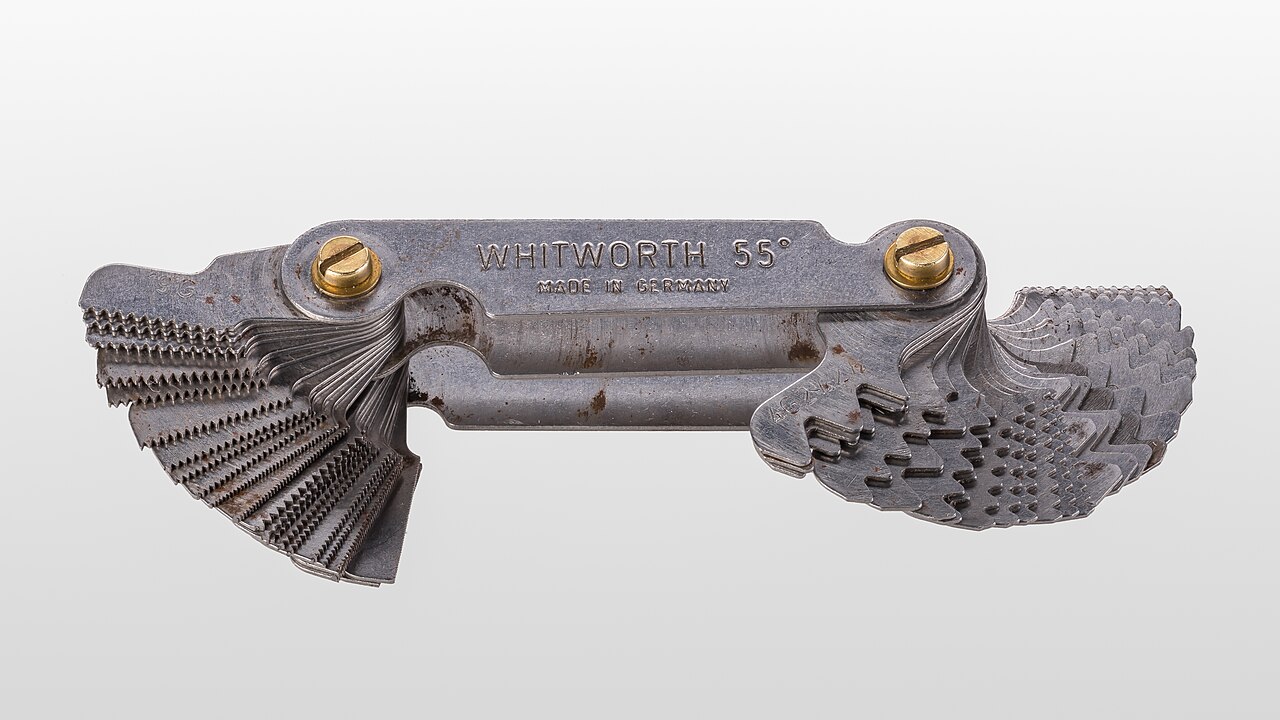
Imperial threads come in two families. Unified threads - UNC (coarse) and UNF (fine), standard in the United States - also use a 60-degree form but are described by threads per inch, or TPI: a 3/8-16 UNC bolt has 16 threads per inch. The older British Whitworth (BSW coarse, BSF fine) and British pipe threads (BSP) use a 55-degree form, which is why an imperial bolt can resist a metric nut even when the diameters match.
Step one in identification: measure the outside diameter of the shank with calipers and compare it to metric or inch tables - about 9.8 mm points to M10, while 9.5 mm (3/8 inch) points to an imperial bolt. Step two: measure the pitch. A thread pitch gauge - the inexpensive comb of profiled blades - gives a direct reading: match the blade that seats fully with no light gap. Metric blades read millimeters, imperial blades read TPI.
Without a gauge, the ruler method works: count how many crests fall within 25.4 mm (one inch). Sixteen threads suggests 3/8-16 UNC. Count over the longest sample you can, since the coarse pitches of overlapping sizes look very similar to the naked eye.
The traps are worth knowing. M8 and 5/16 inch are close in diameter (8.0 versus 7.9 mm) but their pitches (1.25 mm versus about 1.06 mm for 24 TPI) do not match. M10 versus 3/8 inch and M12 versus 1/2 inch are the other classic pairs. A bolt that starts turning but jams after two rotations is the signature of a forced cross-family fit - stop immediately; the threads are already being damaged.
Marking conventions help when heads are legible: metric bolts carry property class numbers (8.8, 10.9), while inch bolts use radial grade lines (three, five, or six lines for grades 2, 5, and 8). Nut sizing follows the same logic, and washer dimensions differ across standards, so do not mix families within a joint.
For buyers, regions remain strongly divided. European, Asian, African, and Middle Eastern equipment is overwhelmingly metric - DIN 933, DIN 931, and ISO standards. North American machinery, classic British equipment, oilfield hardware, and older agricultural tractors stay imperial, and replacements should match the original even when a metric conversion seems close. Exporting to both markets means keeping two clearly separated stock areas and labeling cartons with both thread family and pitch.
Matrix Fasten manufactures both metric fasteners (M5-M48 hex bolts, nuts, washers, anchors) and inch-series equivalents (UNC/UNF hex bolts and threaded rod) for distributors serving mixed equipment fleets. If you can measure the diameter and pitch, send us both figures - our sales engineers will confirm the exact standard before production.