A purchase order that says only hex bolt M12 will produce a valid shipment, but not necessarily the part your assembly needs. Behind that description sit three competing standard systems - German DIN, international ISO, and American ANSI/ASME - and their differences are small enough to pass a visual check and large enough to fail a torque chart or a drawing tolerance.
DIN and ISO are closely related but not identical. DIN 933 (full thread) maps to ISO 4014, and DIN 931 (partial thread) maps to ISO 4017. The head shape, across-corners dimension and thread length conventions differ slightly. A DIN 933 bolt and an ISO 4014 bolt of the same size usually fit the same socket but can differ in head height and in how much thread is supplied on longer lengths. Many older European drawings still call out DIN numbers while the supply chain ships ISO equivalents, and both parties assume the other knows.
Property classes follow the metric ISO 898-1 system: 4.8, 8.8, 10.9, 12.9. The American inch system uses SAE grades 2, 5 and 8, and ASTM designations such as A307, A325, A490 or F1554 for specific applications. Grade 5 is often compared with class 8.8 and Grade 8 with class 10.9, but the comparison is approximate - inch and metric parts are not dimensionally interchangeable even when strength is similar.
Nuts follow the matching logic. DIN 934 maps to ISO 4032. Metric nut classes are 8, 10 and 12 for bolts 8.8, 10.9 and 12.9 respectively. ASTM A563 covers inch nuts by grade, and the pairing rule still applies: the nut must not be weaker than the bolt, or the threads become the failure mode.
Washers and anchors diverge even more. DIN 125 and ISO 7089 flat washers look alike but differ in thickness tolerance. DIN 985 is the nylon-insert lock nut; ISO 7040 is its nearest metric equivalent, and the two are not always accepted as substitutes in safety applications. Anchor designations such as wedge, sleeve and drop-in vary by region and by approval body, which is why anchor selection should follow the local test standard rather than a catalogue number.
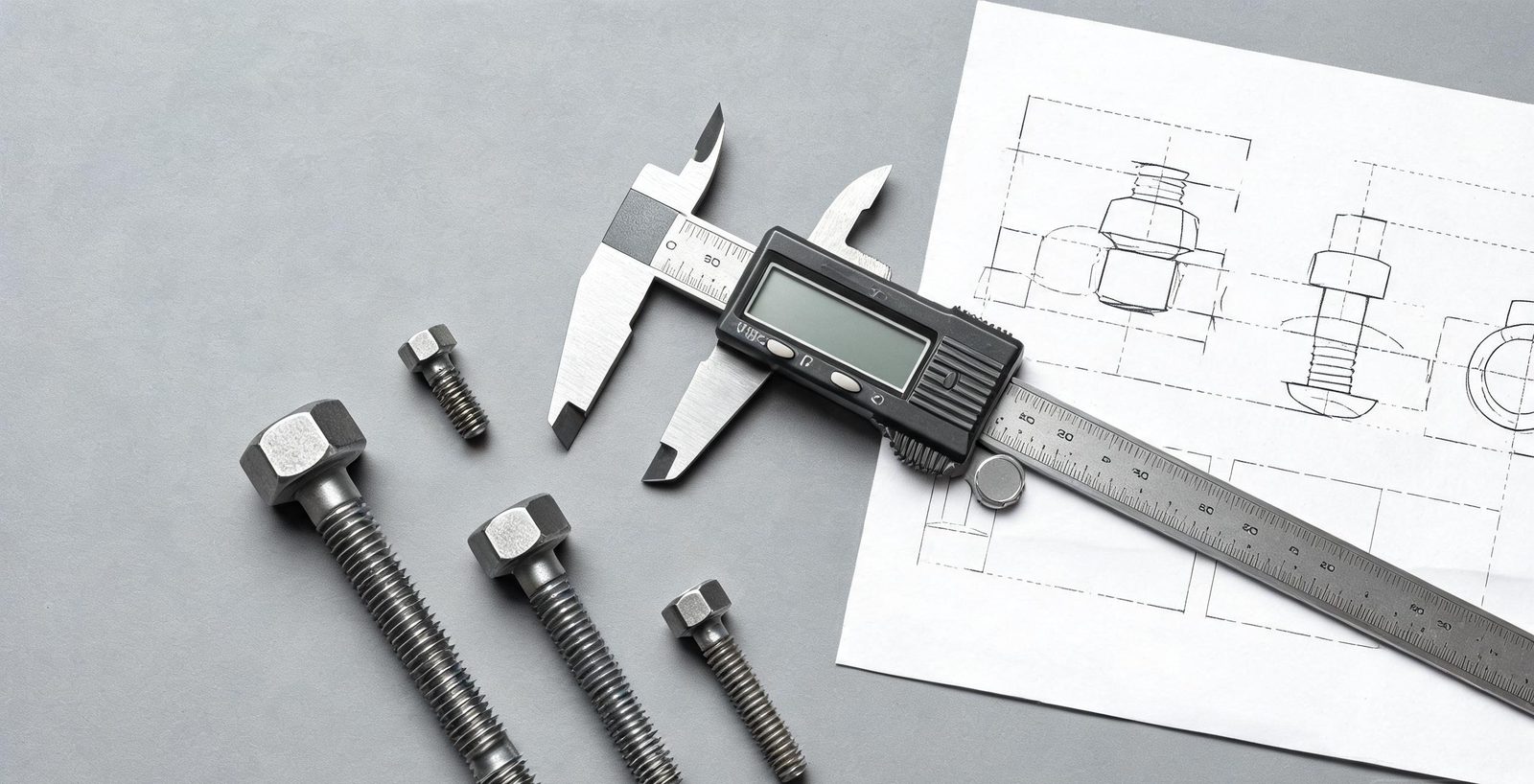
The practical lesson for buyers is simple: state the standard, not just the size. M12 is a diameter. M12x50 ISO 4014 class 8.8 zinc plated 6g is a part. If your drawing is written in DIN and your supplier works in ISO, agree in writing which standard governs, and ask for the first article inspection report to confirm head dimensions, thread length and marking before the full run starts.
One more pattern worth knowing: mixed-standard orders are the most common source of disputes. A container that mixes DIN 933, ISO 4014 and ANSI hex bolts looks uniform on the pallet. Sorting it out at the assembly line costs far more than the fasteners. Keep separate SKUs, separate cartons and separate labels per standard.
Matrix Fasteners produces fasteners to ISO, DIN and ANSI/ASME dimensions, in metric and inch series, and can supply cross-reference tables with each quotation. Send the drawing or standard number and we will confirm exactly which standard and class applies before quoting.